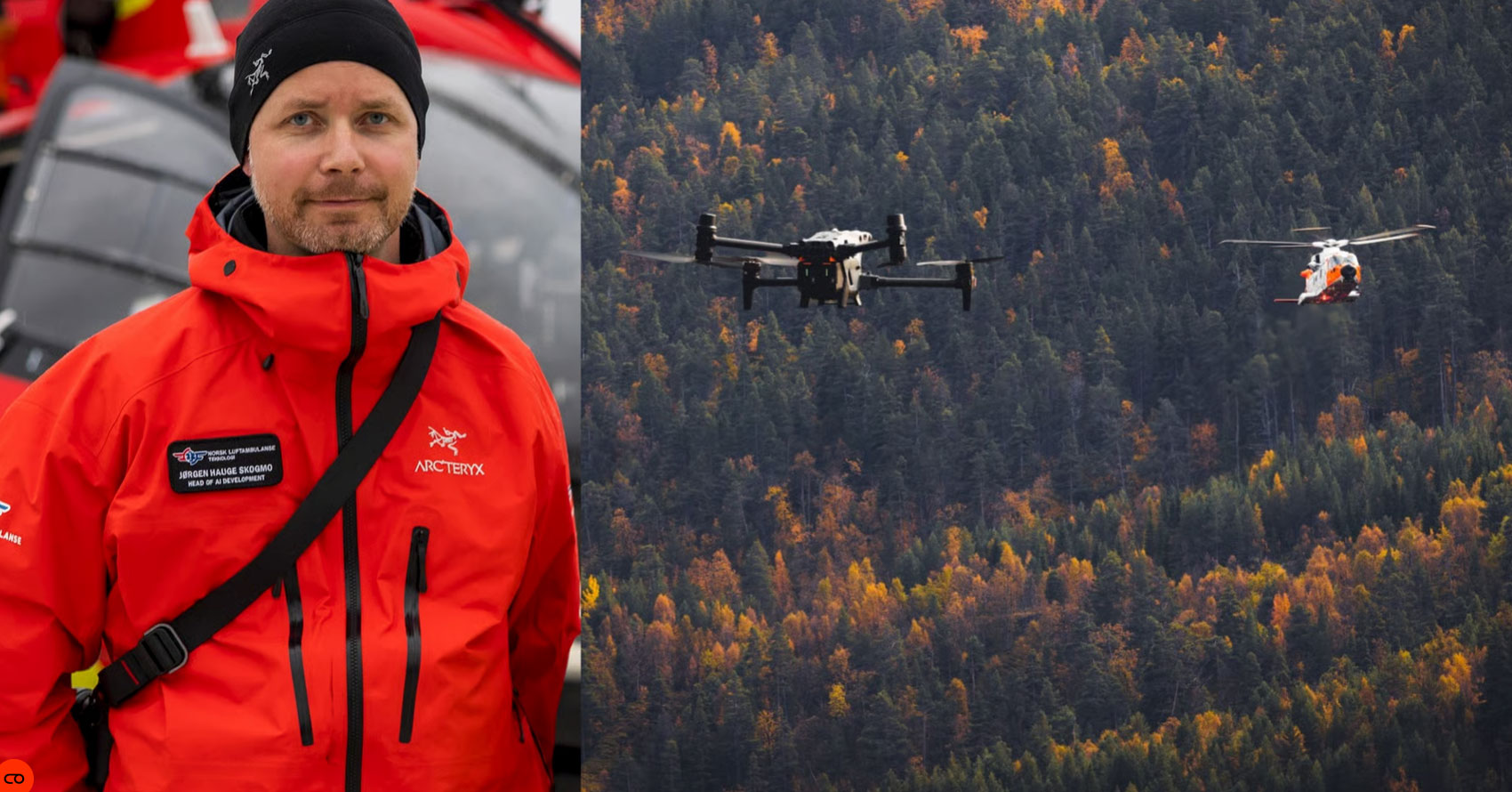
When every minute counts, Jørgen Hauge Skogmo develops technology that can save lives. With the knowledge he gained at Noroff, he uses artificial intelligence to give rescue teams “eyes in the sky.”
While working full time, Skogmo chose to complete the one-year Applied Machine Learning program at Noroff. It required structure and discipline, but the payoff was significant. The program gave him the expertise needed to build AI solutions that can make a real difference in critical situations.
- I’ve always had a strong desire to understand the technology behind the systems I’m responsible for developing.
Developing technology that supports rescue operations in real time
As Head of Development, Skogmo is responsible for creating and leading projects where technology and artificial intelligence support rescue services in real time. He and his team build solutions that collect, analyze, and visualize data from sensors, drones, and helicopters — tools designed to strengthen situational awareness for rescue personnel.
Much of the work centers on bridging advanced machine learning with the practical needs of teams operating in the field.
- We build solutions that gather, analyze, and visualize data from sensors, drones, and helicopters, all with the goal of improving real-time situational awareness for rescue teams.
Machine learning and computer vision in search and rescue
Artificial intelligence has become a crucial part of modern rescue operations. Skogmo and his colleagues use machine learning and computer vision to analyze live video feeds from helicopters, drones, and satellites to detect missing persons or signs of danger in the landscape.
Their systems classify heat and movement signatures, filter out noise, and suggest where the search should continue. Over time, this could evolve into a new kind of decision support — an “AI colleague” continuously monitoring the situation and alerting operators when something seems abnormal, Skogmo explains.
When every minute matters
One of the most exciting projects he is working on is a system for AI-assisted search and rescue that fuses live video from helicopters and drones. The goal is to use computer vision and machine learning to detect people and objects across large distances, even in challenging environments such as forests, open sea, or low-visibility conditions.
The system analyzes the video feed in real time, highlights relevant findings, and feeds them into a shared operational picture that helps rescue leaders make faster, more informed decisions.
Applying his Noroff training every day
Through the Applied Machine Learning program, Skogmo gained both deep theoretical insight and practical tools he now uses daily. The program provided a strong academic foundation for work he had already been doing for years. It also gave him the skills to communicate complex concepts clearly — to developers, pilots, and decision-makers alike.
- The program gave me a solid theoretical foundation for what I had been doing in practice for many years. I use what I learned directly in everything from model training and data processing to evaluating bias, model operations, and explainable AI.
The combination of theory and hands-on work was one of the things he found most valuable. Theory was always connected to concrete tasks — such as building and validating models on real datasets — giving students practical experience from day one.
He explains that several of his student projects directly informed work in his actual job, making the program especially relevant.
A field full of possibilities
For those considering the program, his message is clear: it’s demanding, but absolutely worth it.
- You learn something that is both in high demand and incredibly exciting. You don’t need to be an expert beforehand, the most important thing is curiosity and a willingness to learn. The program gives you the tools to understand and build the systems of the future, no matter what industry you end up in.”
Skogmo believes artificial intelligence is now a natural part of nearly all technological development, and the need for competence is growing rapidly.
-The opportunities are enormous. AI is no longer just a research field — it’s an integral part of almost every area of technology. Those who understand how these models work and how to use them responsibly will be in demand in everything from healthcare and rescue operations to energy and industry.
He hopes more people choose to develop these skills and help bridge the gap between theory and real-world applications.
Related studies

One-year programme
Applied Machine Learning
There are few aspects of our digital lives that are untouched by machine learning. With this programme, you'll teach systems to learn from data. You'll be highly qualified for jobs in AI and can start working straight after graduation.
Online
Oslo, Bergen
Read more
One-year programme
Data Analyst
As a data analyst, you will be one of the most sought-after professionals in today's job market. Your ability to help business leaders make informed decisions using relevant and up-to-date data-driven information will make you a valuable asset.
Online
Oslo, Bergen
Read more